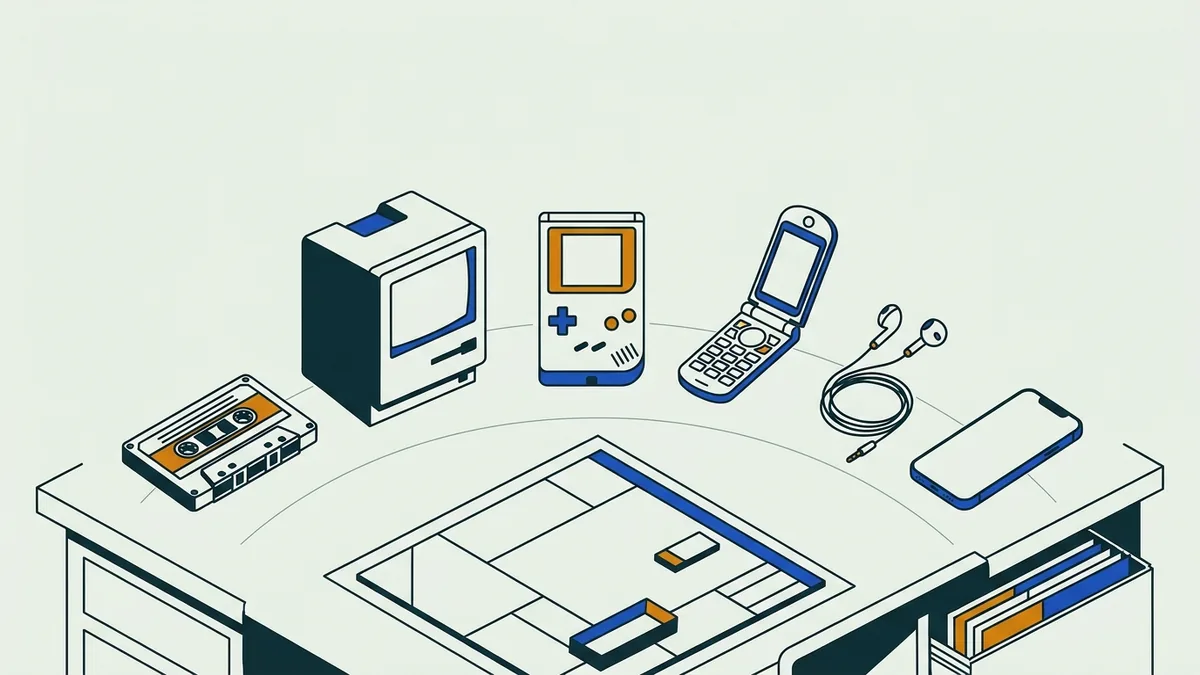
What Are Nostalgia Memory Strata?
Just as geologists date rock by the fossils trapped inside each layer, cultural age quizzes date a player's formative years by the everyday tools, snacks, and media formats that peaked when they were roughly 8 to 16 years old. Those formative memories stack into Memory Strata—distinct generational bands that rarely repeat in the exact same combination twice.
Below is how the five major strata tracked on I Know Your Age map onto real-world 2026 age cohorts, and why border generations like Xennials and Zillennials often show fascinating split charts.
The 1980s Stratum: Analog Independence (Ages 46–65 in 2026)
People whose core cultural memories live in the 1980s stratum remember a world before household internet or pocket screens. Calling a friend meant remembering seven digits and standing near a corded kitchen wall phone; planning Friday TV meant flipping through a paper TV Guide booklet; making a mixtape meant hovering over Record and Play while hoping the FM radio DJ would stop talking before the chorus started.
- Key hardware cues: Foam-pad portable cassette players, manual car window cranks, 35mm film envelopes, and classroom filmstrip carts.
- Why it is unmistakable: Younger cohorts may collect vinyl records as a retro hobby, but almost nobody under 38 has muscle memory of unfolding a glovebox paper road atlas on a family highway trip.
The 1990s Stratum: Dial-Up & Physical Media (Ages 35–45 in 2026)
The 1990s stratum bridges purely analog childhoods and early home computing. Players anchored here grew up rewinding VHS rental tapes before returning them, cleaning lint off ball mice, watching Windows 98 3D Pipes screensavers, and trading Pogs or first-wave Pokemon cards at recess.
- Key tech cues: 56k dial-up modems, Nokia brick T9 texting, overhead projectors with wet-erase markers, and printed MapQuest driving directions.
- Border cohort note: Elder Millennials and Xennials (ages 41–47) routinely split their Memory Strata evenly across the 1980s and 1990s.
The 2000s Stratum: Burned CDs, Flip Phones & Early Social (Ages 27–36 in 2026)
Few decades transformed teenage life faster than the 2000s. This stratum captures the exact window of Sharpie-labeled burned CD-Rs, AIM away messages, MySpace Top 8 drama, anti-skip Discmans, 5-star YouTube ratings, and chunky silver digital cameras unloaded straight into 100-photo Facebook albums.
- Key style & habit cues: Loyal no-show ankle socks, unironic 😂 reactions, side parts, and Googling unknown caller IDs instead of answering.
The 2010s Stratum: SMART Boards, Vine & Early Smartphones (Ages 20–26 in 2026)
The 2010s stratum defines Zillennials and Core Gen Z who grew up during the smartphone handoff. Elementary classrooms traded overhead projectors for 4-corner SMART Board calibration; recess traded Silly Bandz and Rainbow Loom; afternoons belonged to Nintendo DS PictoChat, Coolmath Flash games, Minecraft YouTubers, and 6-second Vine quotes.
- Key giveaway: Watching live cable kids shows early in childhood before switching completely to streaming queues and Snapchat streaks by middle school.
The 2020s Stratum: Streaming-Native & Short-Form First (Ages 13–19 in 2026)
The newest stratum belongs to players who never waited for a commercial break, never synced MP3 files over a USB cable, and entered school alongside rolling Chromebook carts and Google Classroom. Everyday habits—searching inside TikTok, keeping phones permanently on Do Not Disturb, snapping 0.5x ultra-wide selfies, and reacting with 💀/😭—separate this cohort cleanly from players just five years older.
Curious which layers show up strongest on your chart? Run the free age quiz on our homepage or inspect the sharpest guess-my-age questions we use to tell neighboring strata apart.